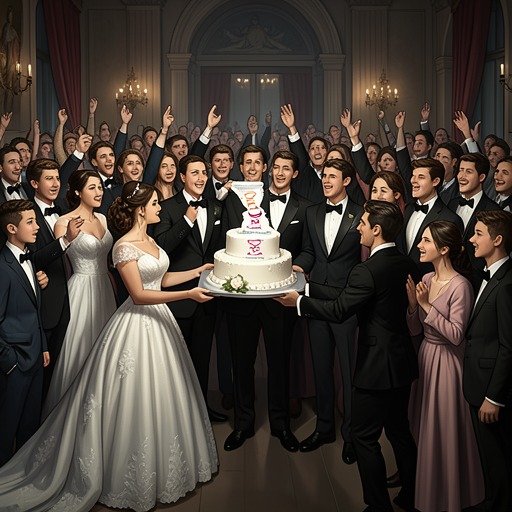
The “Third Wave” of Weddings in One’s Early Thirties
One DayThe “Third Wave” of Weddings in One’s Early Thirties names a change in both the scale and the emotional seriousness of marriage celebrations. In the novel’s account, weddings that once invited parody or retained a homemade informality have become spectacular, meticulously organized occasions. The wave is presented at once as a generational pattern and as a pressure made intimate: when Emma Morley is invited to the wedding of Tilly Killick and Malcolm Tidewell, the words “and partner” expose the gap between the invitation’s assumed social unit and Emma’s actual circumstances.
A generational sequence
The wedding wave is explained through a three-part chronology. University weddings belong to an earlier, deliberately unserious phase. Some students marry in a self-conscious parody of conventional adulthood, with celebrations framed as benign rebellion rather than consequential social events. Their picnics in local parks, secondhand clothes, pub gatherings and modest, homemade gifts make marriage look like a temporary joke shared among friends. Even the photographs preserve that comic register: the bride and groom raise pint glasses, while a cigarette may hang from the bride’s rouged mouth.
By the mid-twenties, the second wave has become less purely playful but has not yet lost its do-it-yourself character. Receptions move to community centres and parents’ gardens; vows are composed by the couple and rigorously secular. A poem about rain recurs as a familiar feature of the occasion. Yet professionalization is beginning to intrude. The emergence of the wedding list signals a change in which celebration is no longer only improvised by friends and family but increasingly organized around formal expectations.
The third wave arrives among people in their early-to-mid-thirties, and the narration marks its difference in tone: no one is laughing anymore. A fourth wave, of second marriages, is projected into the future as comparatively apologetic and constrained by children’s schedules. That contrast makes the present wave seem especially forceful. It is not merely the next age-based stage in the sequence; it is portrayed as the moment when weddings become solemn, elaborate commitments rather than stunts or relaxed gatherings.
Scale and social performance
The material details make the third wave visible before any ceremony begins. Invitations arrive in an “endless cascade” of thick, luxuriously quilted envelopes. Each contains not just an announcement but a comprehensive dossier: telephone numbers, email addresses, websites, directions, dress guidance and gift information. The invitation has become a small piece of planning infrastructure, directing guests through the many tasks required to attend.
The ceremonies and receptions expand to match that paperwork. Country-house hotels are block-booked, salmon are prepared in great quantities, and marquees appear overnight like temporary tent cities. Morning suits and top hats are hired and worn without irony. Florists, caterers, string quartets, ceilidh callers, ice sculptors and disposable-camera makers all have work to do; even Motown cover bands are described as exhausted. Churches have returned to fashion, while the journey from worship to reception may be made on an open-topped London bus, in a hot-air balloon, on matching white stallions or in a microlight plane. The range of transport turns the transition between ceremony and party into another display.
This scale has practical and financial consequences within the narration. A wedding demands substantial reserves of love, commitment and time off work, not only from the couple but also from guests. Confetti costs eight pounds a box, and rice from the corner shop is no longer considered adequate. The contrast between that price and the earlier generation’s candles or compilation tapes compresses the wider change into a single measure: participation in a wedding has become more costly and more carefully managed.
Emma and the invitation
On Thursday 15 July 1999, Emma encounters the third wave not as an abstract social description but as an invitation from Mr and Mrs Anthony Killick to the wedding of their daughter, Tilly Killick, and Malcolm Tidewell. At a motorway service station, she sits in her first car, a fourth-hand Fiat Panda, and studies the invitation. Its wording names her as “Emma Morley and partner.” The phrase assigns her an accompanying person before she has one to bring.
Emma’s response is practical as well as emotional. She is certain that the wedding will include men with cigars and someone English in a kilt, and she tries to orient herself with an ancient road atlas that is missing several major conurbations. Turning the atlas around does not help; she drops it onto the empty passenger seat where her imagined partner would have sat. The empty seat gives the invitation’s social assumption a concrete counterpart. Emma has a car and a route to plan, but no partner beside her, and the elaborate event is already shaping how she imagines her arrival.
Narrative significance
The third-wave account turns a wedding invitation into a measure of changing adult life. Its broad catalogue of venues, clothing, food, entertainment and travel is comic in its accumulation, but the joke has an edge: a celebration of commitment has become an undertaking that absorbs money, time and organization from a large circle of people. The shift from student parody to professional spectacle also changes what a guest is expected to recognize as normal. A picnic and a box of candles belong to the past; the modern invitation arrives with instructions for participating in a much larger production.
The date gives the episode a place in the novel’s recurring sequence of 15 July snapshots. The wedding invitation falls between the 1996 scene involving Emma and the later 2005 anniversary of her death, linking an ordinary social milestone to the book’s longer account of relationships, changing circumstances and loss. The third wave is therefore more than a label for wedding fashion: it supplies the social setting for a moment when Emma confronts, through a small phrase on an envelope, the difference between the partnered life the invitation presumes and the one she is living.